Preliminary Observations on the Effects of Sub-Audible Frequencies in Television on the Human Nervous System
Jason Page
August 2021, Re-written July 9, 2025
Abstract
This study investigates the potential effects of sub-audible Extremely Low Frequency (ELF) modulations, ranging from 0.5 Hz to 20 Hz, embedded in commercial television programming on the human nervous system. These frequencies, purportedly capable of inducing emotional responses such as passivity, anger, or relaxation, are examined for their association with on-screen imagery. Using Fast Fourier Transform (FFT) spectrograms and EEG monitoring, the study aims to identify correlations between ELF signals and neurological responses. Preliminary observations suggest anomalous sub-audible signals in commercial programming, absent in public access broadcasts. The study raises concerns about uninformed public exposure and calls for further controlled research to assess potential societal impacts.
1 Introduction
Commercial television may serve as a medium for mass neurological influence through sub-audible Extremely Low Frequency (ELF) modulations (0.5 Hz to 20 Hz) paired with visual imagery. Historical patents, including US6238333, US6091994, US5782874, US6017302, and US6506148, suggest that such frequencies can induce emotional states like passivity, anger, sexual excitement, sadness, relaxation, or sleepiness. Originating in the 1950s and 1960s under researchers like Prof. Ross Adey and Hendricus G. Loos, these technologies were developed with military intelligence involvement, notably DARPA. This study focuses on sub-audible acoustic signals from modern television speakers, as older CRT-based magnetic field methods are obsolete. The hypothesis posits that ELF modulations in television audio may stimulate the nervous system, potentially conditioning viewers without their informed consent. This raises ethical concerns about short- and long-term individual and societal impacts. The study aims to correlate ELF signals with emotional responses using EEG and assess their association with visual content.
2 Objectives
- Detect and analyze sub-audible ELF signals (0.5 Hz to 20 Hz) in commercial television programming using FFT spectrograms.
- Evaluate neurological responses to ELF-modulated programming versus non-modulated programming via EEG.
- Assess correlations between ELF signals, on-screen imagery, and emotional responses.
- Document findings for potential regulatory action by the FCC and the Department of Health if harmful effects are identified.
3 Methodology
3.1 Phase 1: Signal Detection
- Equipment: A sound board capable of capturing frequencies below 20 Hz, connected to an ATSC digital converter box.
- Procedure: Record 30-second samples of television programming in MTS container format via USB. Analyze samples using FFT spectrograms and dB vs. Hz scopes to identify anomalous signals below 100 Hz, particularly under 20 Hz, distinct from audible frequencies above 100 Hz.
- Exhibit Placeholder: FFT spectrograms for examples A, B, C, and D (to be inserted).
3.2 Phase 2: Neurological Response Testing
- Participants: A small pool of volunteer subjects.
- Setup: Subjects are connected to an EEG to monitor frontal lobe activity.
- Procedure: Expose subjects to two conditions:
- Programming with documented ELF frequencies and associated imagery.
- Programming with identical imagery but without ELF frequencies.
Compare EEG responses to identify correlations between ELF presence and neurological activity.
- Reporting: Compile results and, if strong correlations indicate potential harm, submit a report to the FCC and the Attorney General’s Office of the Department of Health.
4 Preliminary Observations
FFT spectrograms reveal anomalous sub-audible signals in commercial television programming, including regular shows and commercials, below 100 Hz and often below 20 Hz. These signals are absent in public access television. Specific examples include:
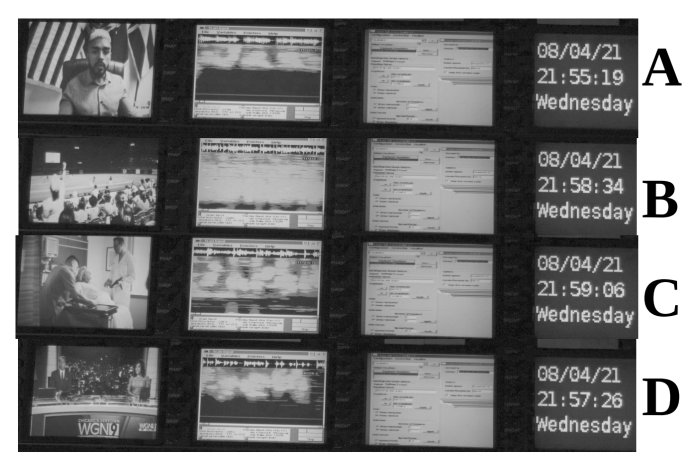
- Example A: No sub-audible activity below 100 Hz.
- Example B: Signals extend to 20 Hz with distinct signatures below 20 Hz.
- Example C: Distinct signatures below both 100 Hz and 20 Hz.
- Example D: Signals below 100 Hz but absent below 20 Hz.
[Figure 1: FFT Spectrograms of Television Audio Samples]
5 Public Health Concerns
Sub-audible ELF signals may elicit nervous system responses without viewers’ awareness or consent. Patents suggest intentional use of ELF to induce emotional states, potentially manipulating unsuspecting audiences, particularly developing minds. FFT analysis indicates:
- Similar patterns above and below 100 Hz and 20 Hz may emphasize emotional responses.
- Distinct patterns across these ranges may indicate manipulative intent beyond audible content.
Such practices, if confirmed, could undermine public autonomy and mental health, necessitating regulatory scrutiny.
6 Recommendations for Future Research
- Longitudinal Study on Chronic Exposure Effects: Investigate the cumulative impact of prolonged exposure to ELF signals in commercial television on mental health and behavior. Conduct a multi-year study tracking participants’ emotional regulation, stress levels, and cognitive function using psychological assessments and neuroimaging (e.g., fMRI) to determine if chronic exposure leads to lasting neurological or psychological changes.
- Content-Specific Emotional Manipulation Analysis: Examine whether specific types of television content (e.g., advertisements, news, dramas) paired with ELF signals elicit distinct emotional or behavioral responses. Use controlled experiments to compare viewer reactions to content genres with and without ELF, analyzing responses through self-reports, physiological measures (e.g., heart rate variability), and EEG.
- Cross-Platform ELF Signal Comparison: Extend the analysis to other media platforms, such as streaming services, video games, or social media, to determine if ELF signals are present and how their effects compare to those in traditional television. Employ FFT spectrograms and audio analysis to detect sub-audible frequencies across platforms and assess their prevalence and intent.
- Demographic Variability in ELF Susceptibility: Study how age, gender, and pre-existing neurological conditions influence susceptibility to ELF-induced emotional responses. Recruit diverse participant groups and use EEG and behavioral assessments to identify variations in nervous system responses, focusing on vulnerable populations like children or individuals with anxiety disorders.
- Ethical and Regulatory Framework Development: Research the ethical implications of ELF use in media and propose regulatory guidelines. Collaborate with neuroethicists, media scholars, and policymakers to evaluate consent, transparency, and potential harm, using case studies of ELF applications to recommend standards for media production and broadcasting.
7 Conclusion
Preliminary evidence suggests that sub-audible ELF signals in commercial television may influence viewers’ nervous systems without their knowledge, raising significant ethical and public health concerns. The presence of anomalous signals, absent in public access programming, warrants urgent investigation. Controlled studies are essential to assess the extent of potential abuse and its impact on societal order. Regulatory bodies must prioritize transparency and informed consent to protect public well-being.
References
[1] US Patent 6238333.
[2] US Patent 6091994.
[3] US Patent 5782874.
[4] US Patent 6017302.
[5] US Patent 6506148.


